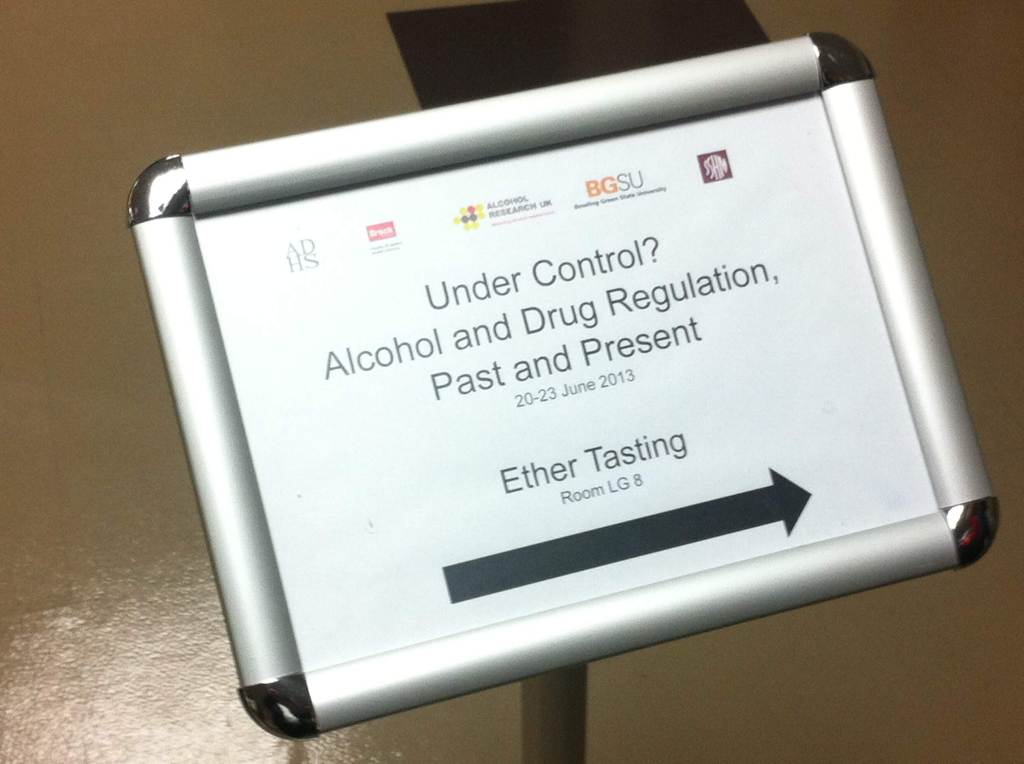
Ten years ago I helped Dan Malleck, Alex Mold, James Nicholls and Noelle Plack organize a conference for the Alcohol and Drug History Society at the London School of Hygiene and Tropical Medicine. The website is still up, showing off the wide range of papers presented by our speakers. We also organized a conference ‘fringe,’ a set of events for those more sociable moments between sessions and at the end of the day. There was a themed music playlist, a common-or-garden drinks reception, and a trip to study the compartments of a Victorian pub (the Princess Louise), plus a temperance revival meeting for the Keppel Street branch of the Band of Hope, established especially for the conference, which I may blog about another time.
But on the opening night we gathered together to drank ether after hearing a plenary paper from Scott Martin, the then-president of the ADHS. Ether, or diethyl ether, was used as an anaesthetic from the middle of the nineteenth century but it was also consumed for fun, as described in Mike Jay’s Emperors of Dreams. Jay had worked with food artists Bompas and Parr, and they had already run ether tastings at public events. I’d taught Sam Bompas and had passed him some drink-history-related ideas that he’d worked up into interesting events. I wondered if he would be interested in running something for the conference… and luckily for us he was.
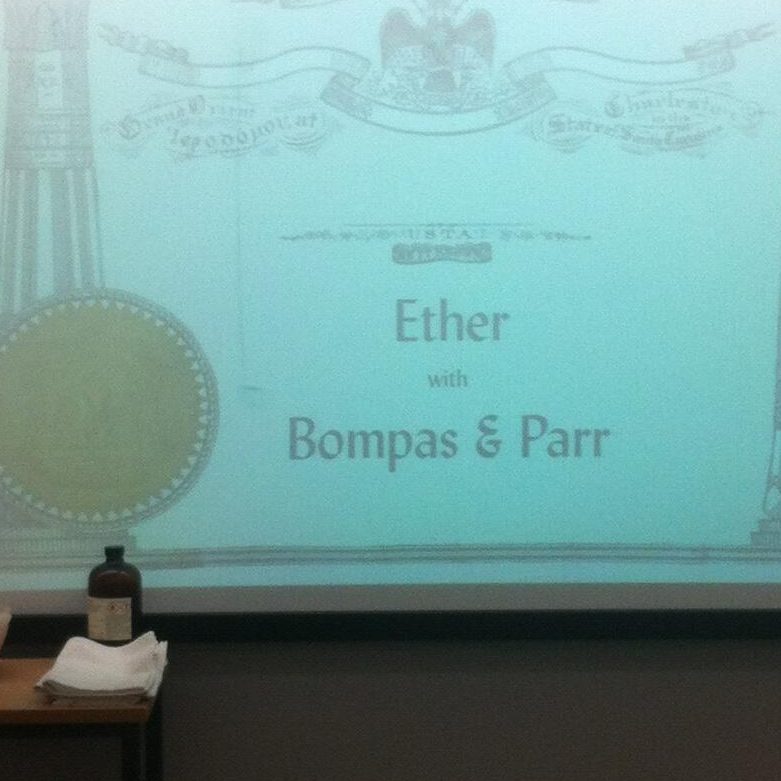
Sam spoke briefly about the history of ether’s recreational use before offering us the chance to imbibe some. Ether is quite difficult to consume because it’s highly volatile – it quickly boils off into the atmosphere. Body heat is too much for it and it can be painful to breathe. Victorian ether drinkers cooled their mouths with water, washing their ether down with further glasses of water. You can always soak a napkin in it and sniff away, but that feels pretty sordid.
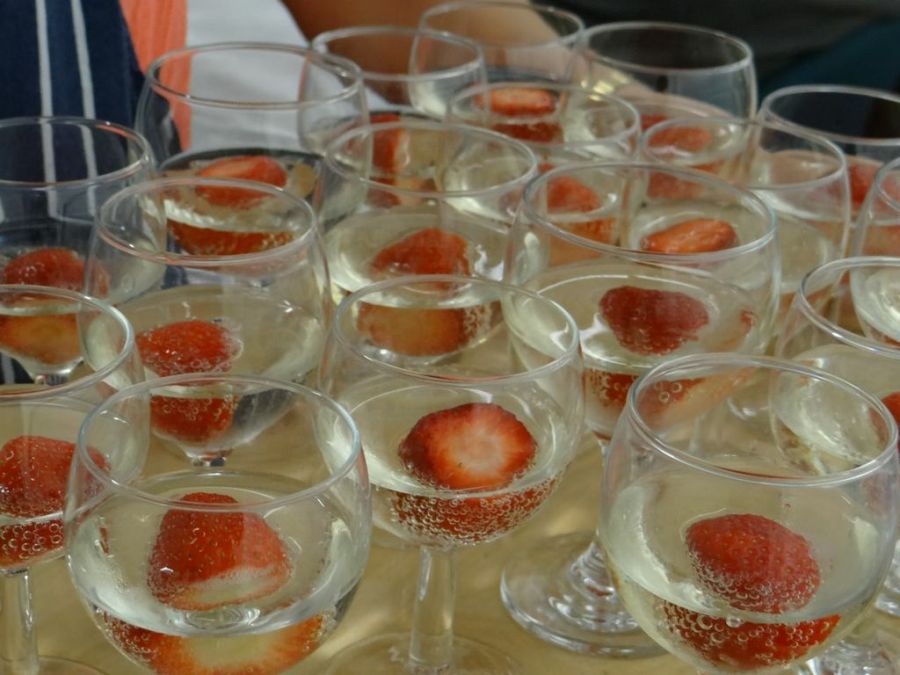
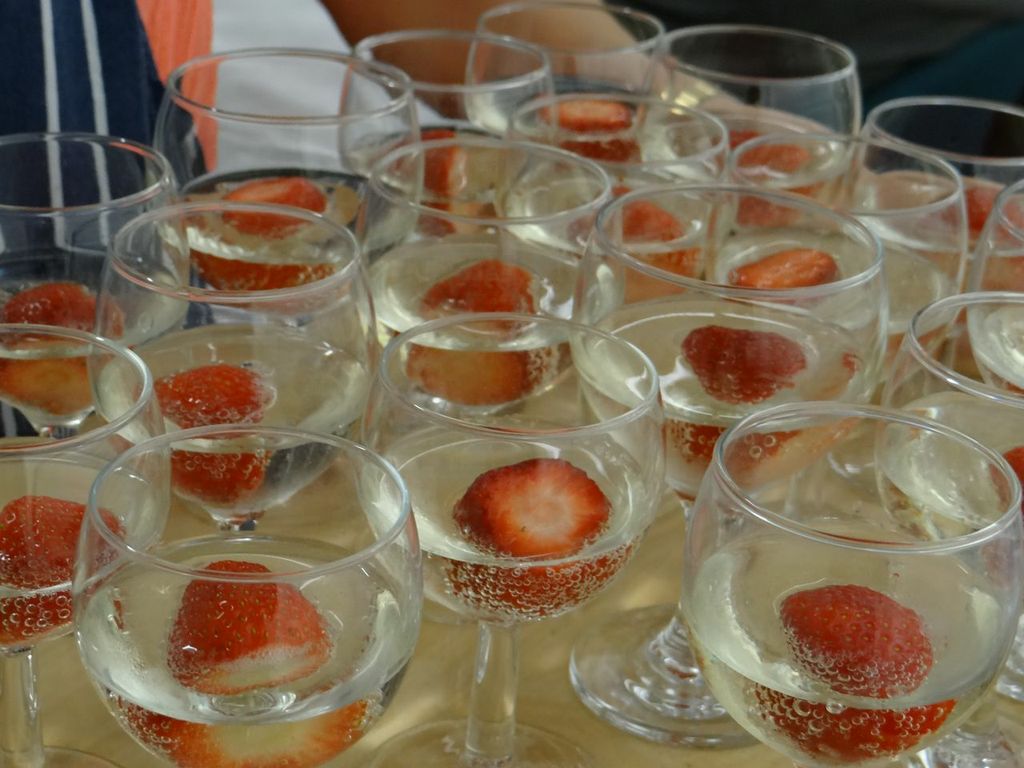
Luckily Bompas and Parr think these things through. We were offered glasses of champagne in which strawberries fizzed happily away because it turns out that strawberries will soak up a drop of ether, releasing it much more slowly in a bath of champagne than would be the case if the ether was sitting in a glass on its own. You end up inhaling the ether and drinking the champagne, which is a very pleasant combination.
The second cocktail was the Eagle Tail, a mix of absinthe and ether, and was apparently the creation of Aleister Crowley. I can’t remember the exact recipe, and it’s not listed in Bompas and Parr’s book Cocktails, but I do know 10% of it was ether. (I can’t imagine Crowley knew the full ingredients or the right proportions either. He doesn’t strike me as a details man.)
The evening was a highly successful introduction to the conference, and I very much enjoyed seeing our delegates getting to grips with diethyl ether. It nearly didn’t happen, though, because our hosts at the School very sensibly required us to fill out a risk assessment form before they gave us permission for the event. Ether is highly flammable and very intoxicating. If it hadn’t been for the 2007 ban on smoking I don’t think we would have got away with it, but Bompas and Parr do this kind of thing all the time and we were able to lean on their professional credentials. We listed a dozen control measures to mitigate the risks, making it clear this would be an “educational and informative” event and not an ‘ether frolic.’ We did not mention Crowley. To my surprise we were given the green light.
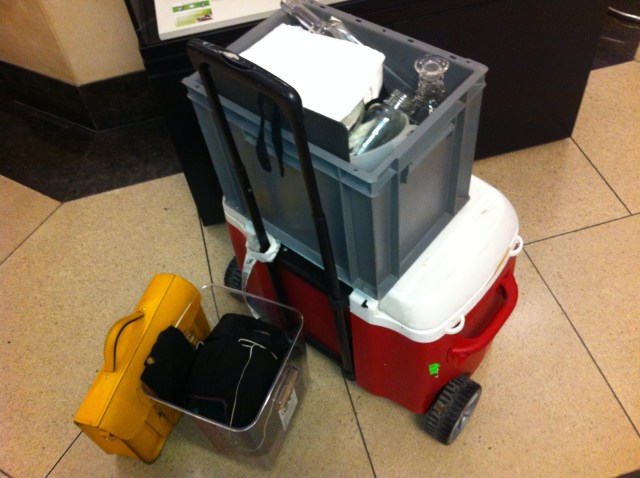
Sorting out the risk assessment provided an interesting opportunity to think about ether as an intoxicating substance. Ether’s properties make it a different proposition to other intoxicants when it comes to consuming or managing it. It’s licensed in a different way to alcohol – the assumption is you’ll be using it in an industrial or medical setting, a lab rather than a seminar room (or bar.) The equipment Sam needed to bring (above) looked more like the kind of kit physical geographers take on field classes.
Ether-drinkers had to do a good deal of experimenting to find out how to get a buzz off it, precisely because it’s such a lively substance. And at our tasting alcohol was not the focus but simply the medium through which consumable ether could be transferred into the body, much as medicines were dissolved in wine or port in the nineteenth century. The champagne and absinthe were also licensed, of course – absinthe was banned in some countries for much of the twentieth century, after all – but the School was used to managing the risks associated with boring old alcohol. Faced with an intoxicating substance that is keen to turn into vapour and is highly flammable, the School wisely asked us to vouch for its safety, responsibilizing us much as ordinary licensing does with alcohol vendors and consumers.
It was very much worth doing, and as a welcome to the conference it worked very well. I don’t think I’ve ever organised anything, academic or not, that has generated as much FOMO for people who weren’t there as this event has. Maybe we should do it again.
James Kneale
DISCLAIMER: Ether can be very dangerous; it can ignite even when no naked flame is present.
Always consult a professional food artist or other licensed practitioner before consuming ether.
 James Kneale